Chercheurs d’eau is always on the lookout for slightly different trips, where divers are no longer mere onlookers of the underwater world but true contributors who help advance scientific knowledge of underwater species. This is exactly what Blue Mind Expeditions offers on the trips it runs around the world, and in particular in the Azores.
Dive tourism is not neutral for our planet: its carbon footprint is very real, and not knowing how fragile the marine environment is sometimes leads to destructive practices. Starting from this observation, Margaux Le Brun and Anthony Le Floc’h decided to create Blue Mind Expeditions. Their aim is not to stop divers from travelling, but to offer them a new way of living each dive as an experience that is at once enriching, educational and useful to science. The trips offered by Blue Mind Expeditions let divers deepen their knowledge of the marine species they are about to meet, and also take part in citizen-science activities by collecting data to share with local scientific bodies. On these trips, Margaux and Anthony draw on their knowledge of marine biology, their experience as naturalist dive guides and their skill in wildlife photography to give the divers who join them caring guidance, for dives that are exciting, respectful and often full of emotion.
Heading for the Azores to meet the blue shark
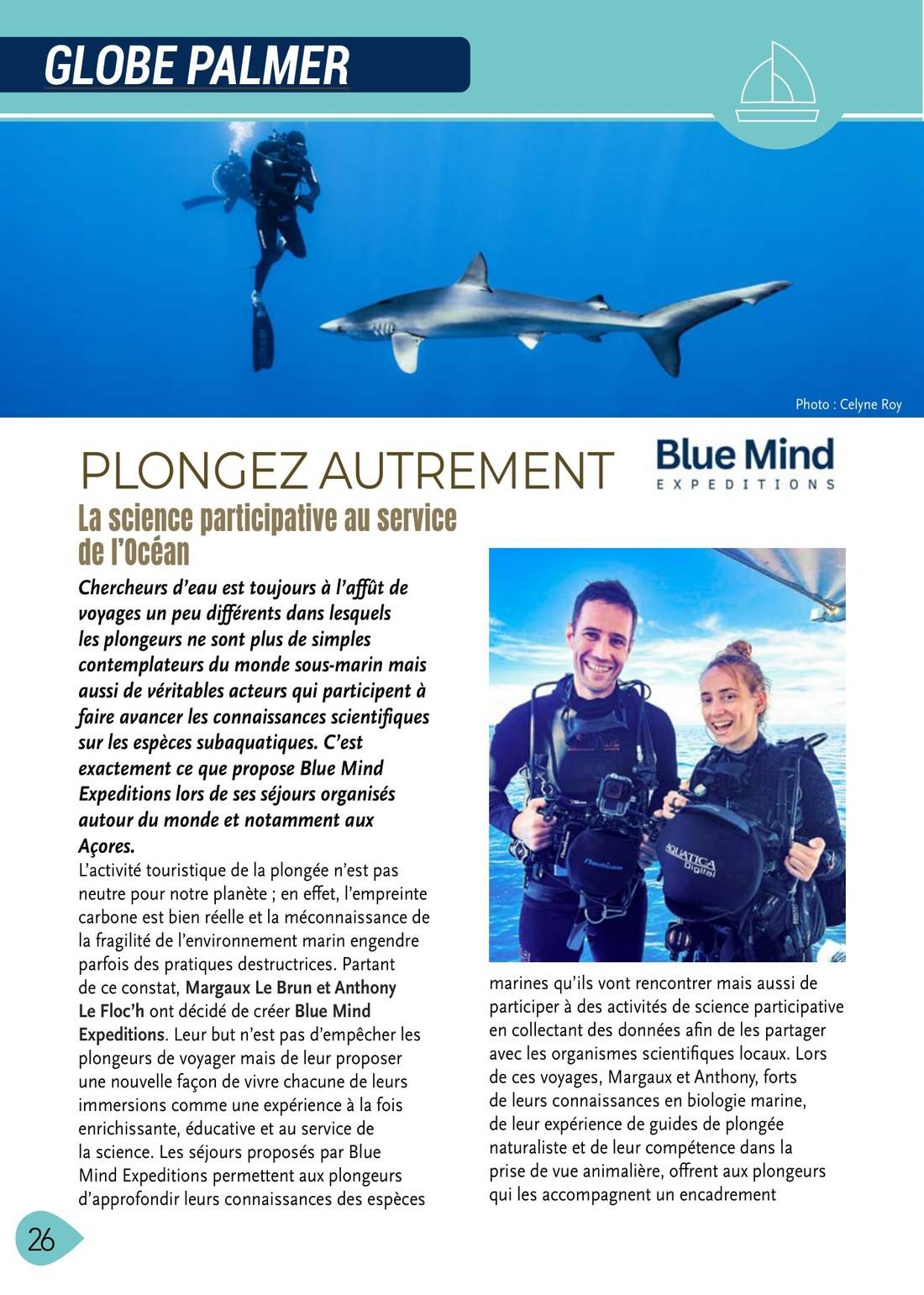
One of the most sought-after Blue Mind Expeditions trips takes place just a few hours’ flight from France, on the island of Pico in the Azores. The main subject of this trip is the blue shark, a fascinating species within the great shark family but, sadly, also the most fished in the world. Unlike other marine animals such as the whale shark or the manta ray, there is still no standardised protocol for identifying individuals of this species. That makes it hard to collect precise information to track their movements or to measure how faithful they are to the sites they visit, yet this data is essential to protect the species. To fill this gap, Margaux, who holds a degree in marine biology, is working with a group of young researchers to develop a reliable, repeatable photo-identification method that can be used anywhere in the world. The blue shark (Prionace glauca) is common in Azorean waters, which makes this the ideal destination to meet it, put the method into practice and study its behaviour. That is largely what this trip is about!
Every year, between June and September, Margaux and Anthony welcome small groups of up to 7 divers for a week on the island of Pico. They stay close to the harbour and to the dive centre, which provides its boat and a skipper to the Blue Mind Expeditions team. On the first day, two coastal dives are devoted to discovering the very particular atmosphere of the Azores’ volcanic seabed. The following days are dedicated to the blue shark, with short talks on the biology of the species, the value of citizen science and the challenges of conservation. Margaux and Anthony also run a few practical workshops on how to behave underwater around sharks and on the scientific data collection techniques that the divers and photographers in the group will get to try. The 6 dives scheduled off Pico give the best chance of observing blue sharks, collecting data on their behaviour and photographing the different individuals encountered, to feed a local identification register. Each evening is then given over to a debrief of the day’s dives and a review of the images, in a friendly atmosphere where everyone can share what they experienced underwater or ask questions.
During the trip, participants have one free day. They can spend it exploring the island, taking a boat trip to swim with dolphins (more than ten species live in the Azores) or heading out to sea to see whales. They can also ask Margaux and Anthony to organise a small diving expedition to Princess Alice, a legendary seamount classified as a fully protected marine area since January 2026. This famous, world-renowned spot is visited by majestic mobula rays, barracudas, large bonitos, jacks and sometimes whale sharks. Having dived the site a few years ago, our Chercheurs d’eau team can promise you will not be disappointed if you choose this option…
If you would like to know more about these citizen-science trips in the Azores, or discover the other trips of this kind run by Blue Mind Expeditions:
- www.bluemindexpeditions.com
- contact@bluemindexpeditions.com
- Phone: +33 6 12 18 30 43
- Instagram: @bluemind_expeditions
- Facebook: Blue Mind Expeditions
(Photos: Blue Mind Expeditions, Fabrice Boissier, Celyne Roy)